 Act
No payment tool where none belongs.
The step that reads the claim never sees a payment tool, so even a model that is talked into it has nothing to call. Each step gets only the tools its policy allows.
Governance for AI agents
Set tool permissions, require human approval for selected actions, and test changes before release. Actspan connects these controls with evidence from supported agent runs.
YAML-firstCLI-nativePortal-connected
Example: a refund agent
Refunds up to $100 are automatic, up to $500 need a person, and above that are refused. Those rules are a few lines in your payment service, and they should stay there. The hard part is the agent around them.
The step that reads the claim never sees a payment tool, so even a model that is talked into it has nothing to call. Each step gets only the tools its policy allows.
The agent stops mid-run with the exact claim and amount, a reviewer approves or rejects, and the payment step cannot run without that approval. No queue or resume logic to build.
Configuration, policy decisions, the approval and the payment receipt are linked in one run record. An answer that claims a refund with no matching receipt fails.
Tested on OpenAI and Claude, natively and through LangChain, with sandbox payments: $75 paid once, $250 never paid without approval, $750 refused, and payment IDs matched the ledger. In one test a model was talked into paying another customer's claim; the payment service refused it. See who enforces what
Governance across the lifecycle
Define what agents can do, check behavior and supported controls, then inspect what happened. Governance connects development, delivery, and operations.
Define prompts, agents, tools, and workflows in YAML. Validate configuration and run locally with the same CLI you use in CI.
Understand dependency impact, test supported controls, evaluate behavior, and connect release approval to the exact configuration.
Inspect recorded runs, usage, costs, and failures. Compare behavior over time and bring the available evidence into one record.
Governance travels with the work. Policies, ownership, and evidence connect all three stages.
See coverage boundariesOne control plane across the agent lifecycle. See the architecture and current boundaries ↗
A workflow developers recognize
Real commands. Version-controlled configuration. Explore a company-research workflow from definition to inspection.
workflows:
  data_enrichment:
    steps:
      - agent:
          id: web_research
          ref: web_research_agent
          input:
            input_text: "${INPUT_TEXT}"
      - agent:
          id: summarize
          ref: summarize_agent
          after: web_research
          input:
            input_text: |
              Topic: ${INPUT_TEXT}
              Research JSON:
              ${web_research.output}
    output:
      from: summarize.output
      format: json
The public example composes two declared agents: research, then summary. Understand the agents and data flow ↗
# From actspan-examples/openai/data_enrichment
export OPENAI_API_KEY="<your-openai-api-key>"
actspan init workspace.yaml
actspan validate workspace.yaml --strict-env

# Check readiness before a provider call
actspan preview workspace.yaml --format json

# Run with your configured OpenAI credential
actspan run workspace.yaml data_enrichment \
  --input-text "NVIDIA Corporation" \
  --format text
Init creates local settings in .actspan.env. Validation and preview make no model calls. A live run uses your OpenAI account and incurs usage charges. Keep the key private in your shell. Download the example files ↗
# Smoke-test the first case from the two-case summary suite
actspan eval run \
  eval_summarize_data_enrichment.yaml \
  --mode smoke --fail-on-constraints

# The report includes:
# • Passed and failed cases
# • Required constraint outcomes
# • Recorded cost and report locations
Smoke mode runs the first of two supplied research fixtures through the summary model and checks output structure and topic. It does not rerun web research or establish factual accuracy. Evaluations incur provider charges. Failed constraints return a nonzero exit code for CI. Build an evaluation suite ↗
# Find recorded executions
actspan runs

# Use the run ID printed by your execution
actspan inspect <run_id>

# Connect your team's configured portal
actspan portal connect --workspace-dir .
actspan portal status --verify --workspace-dir .
Local history works before portal setup. Future connected runs can publish evidence. Understand the run record ↗
Interactive command walkthrough · No agent execution or credentials in this page.
For design partners · recorded portal screens
Real screens from local OpenAI and Claude refund trials. A browser reviewer records the decision; the original CLI workspace resumes the run.
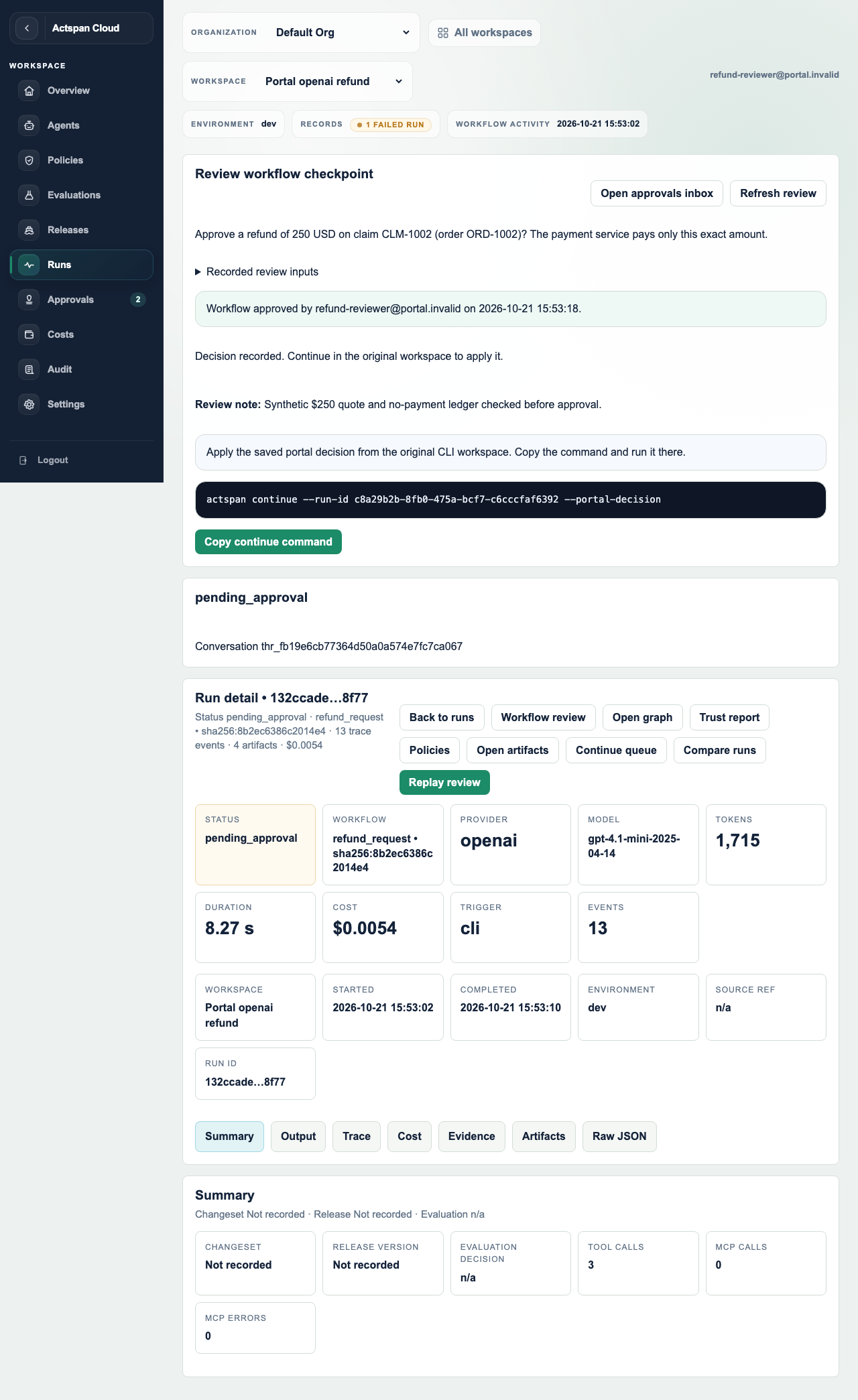
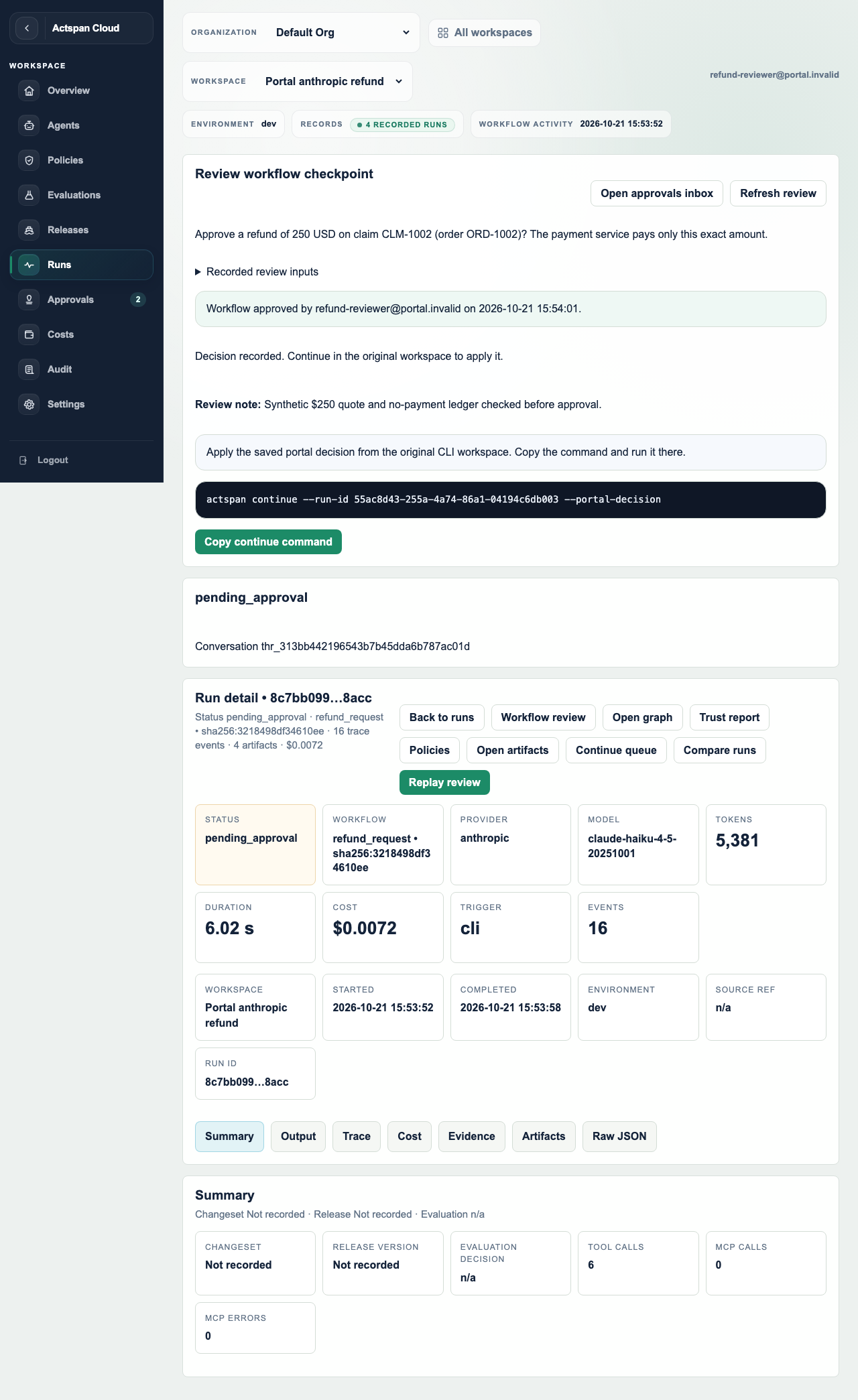
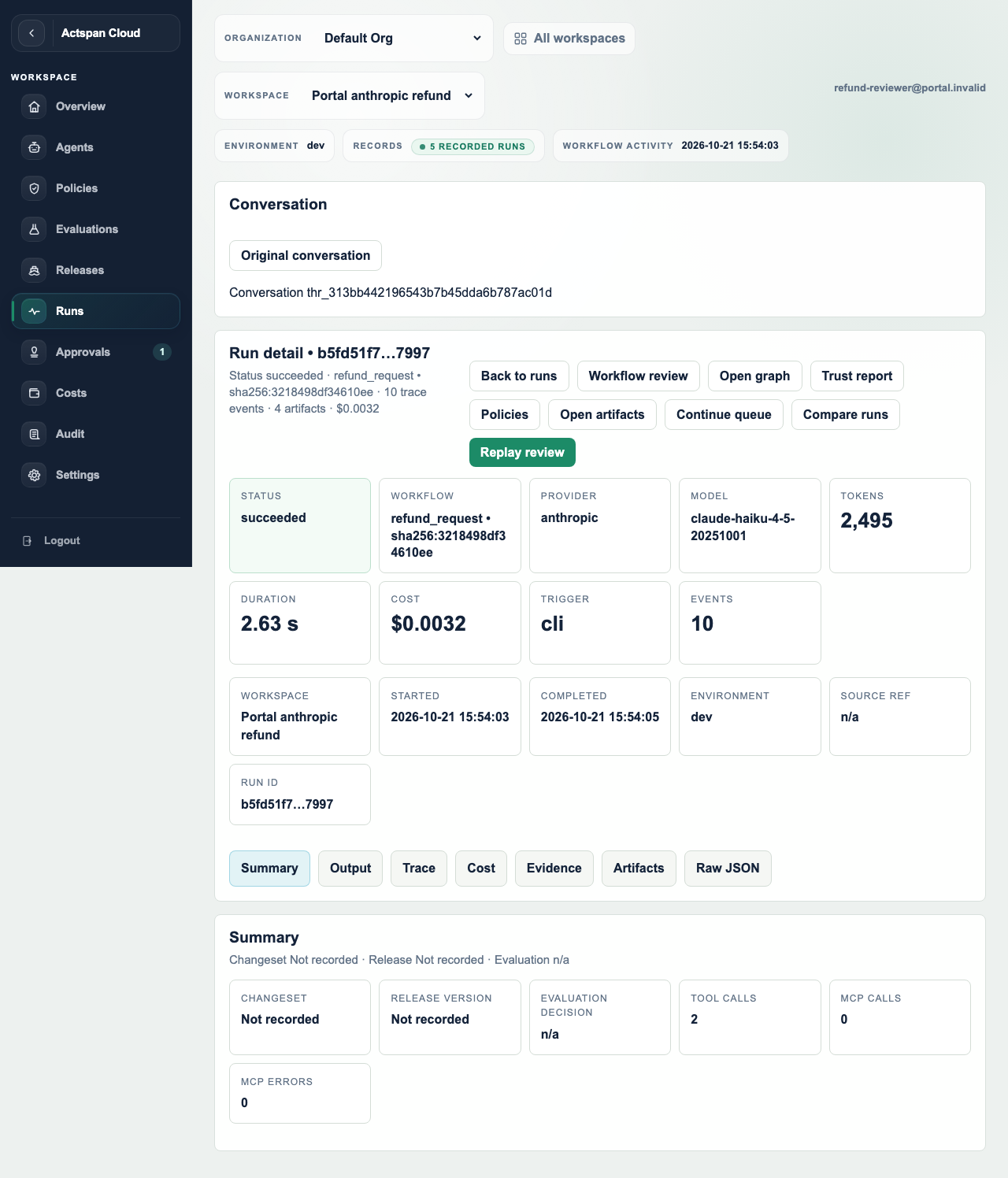
Recorded October 21, 2026 on core 0.1.2 with OpenAI plugin 0.1.1 and Anthropic plugin 0.1.0. Synthetic identities and payments; local browser-session authentication and CLI-owned execution. These screens do not qualify production OIDC or portal-launched runners. Follow the approval flow ↗
Use cases
A $250 refund waits for a person. A $750 request is refused without a payment.
Tested: sandbox refunds. Not yet tested: payouts and disputes.
B2B SAASThe agent can open a support ticket. A read-only agent is blocked before it writes.
Tested: local authenticated ticket workflow. Not yet tested: account and subscription changes.
AI AGENCIESShow your client what the agent is allowed to do before you hand it over.
Built on the same tested controls. We're looking for agency design partners.
Tested labels describe local synthetic workflows. See the verified scope. Research, planning and support walkthroughs remain in the OpenAI developer examples ↗.
Free CLI. Local evidence.
Install Actspan, copy the self-contained example from the quickstart, then validate and preview before a live run. No repository or portal account is required.
0.2.0 CLI · Apple Silicon macOS · Python included. Ad-hoc signed; not Developer ID-signed or notarized. Release notes. Downloads are hosted on S3 through public HTTPS delivery. Download the public research, planning, support and native refund examples. Hosted portal access and the optional LangChain adapter are supplied separately to design partners.
--version check, then complete the installation shown in the guide.Apple’s opening instructions explain this per-app exception.
(
set -eu
mkdir -p "$HOME/actspan-installer"
cd "$HOME/actspan-installer"
curl --fail --silent --show-error --location --proto '=https' --proto-redir '=https' \
  https://d3jf0s2r29lnlr.cloudfront.net/install.sh -o install.sh
echo '93be140d34b290b3d4a69486138d3cbb4c8f7d756030aa72177edd9c3ce0ae70  install.sh' | shasum -a 256 -c -
bash install.sh --version 0.2.0
)
export PATH="$HOME/.local/bin:$PATH"
actspan --version
Verify the hash before running the installer. Download installer · Free CLI installation guide ↗. The short actspan.com/install.sh URL awaits the domain cutover; use the verified download endpoint above for now.
A few useful details
Know what you're adopting and what the evidence can tell you.
Define agents and their allowed capabilities, evaluate behavior, apply supported controls during execution, and inspect recorded activity. The CLI and portal connect these tasks across the lifecycle, with release review where your workflow requires it.
No. You can define and execute supported agents and workflows directly through Actspan YAML and CLI. The current getting-started path does not require a framework adapter. If your agent already uses LangChain, the optional LangChain adapter checks its model and tool calls without rewriting the graph.
The native OpenAI refund example has live checks for automatic, approval-required, and blocked refunds, with sandbox payment receipts checked against the ledger. Native Anthropic Claude Haiku 4.5 has passed local end-to-end checks: $75 paid once; $250 paused with no payment, then approved and paid once or rejected with no payment; and $750 blocked with no payment. Returned payment and quote IDs matched sandbox ledger receipts.
LangChain adapter 0.1.1 with core 0.2.0 passed the local $75/$250/$750 refund checks on both OpenAI and Claude; its $250 case denies the reviewed payment rather than using Cloud approval. Local Ollama customer-service and data-enrichment workflows have separate live CLI, SDK, and evaluation checks; customer service also has local-review checks. These results cover the named local workflows and sandbox payments. Approval checks used local reviewer decisions in those refund matrices. Separate historical local Cloud checks on core 0.1.2 passed for the standalone OpenAI 0.1.1 and Anthropic 0.1.0 plugins: a browser-authenticated reviewer approved $250; changed agent permissions blocked continuation before payment or approval consumption; restoring the reviewed configuration allowed one receipt-matched payment. Azure OpenAI, Amazon Bedrock and Vertex AI have not yet been verified for this refund workflow. These checks used synthetic payments and a local browser session; deployed production reviewer authentication and other provider workflows need their own qualification. Listing a provider integration does not establish equivalent tool execution or approval coverage. See the release provider and adapter verification matrix.
actspan verify exercises supported controls using deliberate violations and reports passed, failed, unsupported, and unverified checks. It does not prove all possible agent behavior is safe. Full workflow execution is currently an unsupported verification probe.
Coverage applies to configured Actspan execution and reporting paths. Calls that bypass those paths are not automatically observed or controlled. Evidence packages expose missing and unsupported records.
Yes. Use the CLI for local validation, execution, evaluation, and inspection. Connect a portal when you need shared review, approvals, deployments, and connected evidence packages.
Start with one real workflow. Define the controls it needs, then measure control coverage, prohibited actions and changes blocked, false blocks, and runtime traceability. Evaluate task quality against your dataset; measure cost visibility and investigation effort alongside integration effort. Read the pilot measurement plan.
Design-partner program
Start with a 15-minute fit conversation. In a working session of about two hours, we set up the controls your agent needs, such as tool permissions, approvals, and budgets, and compare the result with how you investigate today. Design partners get direct roadmap influence, hands-on setup, and early-partner pricing.